51
Promenade / Re: Aquaculture
« Last post by Kenguru on March 02, 2020, 08:03:28 AM »As I read through my first post, I feel like I have to point out that I also no longer smoke dope.
 Recent Posts
The gnats of the third species exceed not the bigness of a grain of mustard. The colour is red. These sting not at all, but do bite so sharply upon the flesh as to create little ulcers therein. When it often comes that the face swells and is rendered hideous to the view, through this inconvenience.(Esquemeling, 33)
…these apples being eaten by any person, he instantly changes colour, and such an huge thirst seizes him as all the water of the Thames cannot extinguish, he dying raving mad within a little while after…. This tree affords also a liquor, both thick and white…which, if touched by the hand, raises blisters upon the skin, and these are so red in colour as if it had been deeply scalded with hot water. One day being hugely tormented with mosquitos…and as yet unacquainted with the nature of this tree, I cut a branch thereof, to serve me instead of a fan, but all my face swelled the next day and filled with blisters, as if it were burnt to such a degree that I was blind for three days.(Esquemeling, 32)
 It was also used to make the varnish used on violins. Around 1640 Jesuit priests introduced Peruvian bark (quinine) to Europe from South America. It was used to cure intermittent fevers, such as
 It should be taken in the intermissions between
the hot stages, in the dose of a grain every hour, an
emetic at the commencement of the chill, and a purge of
Calomel and Jalap afterwards having been given before
commencing with the quinine.(Druett, Rough
Medicine, 61)
, all of which a pirate might encounter when visiting exotic places. Unguents were used to treat burns and abrasions.
…we were not many dayes at Sea but there began amongst our people such mortality, as in a few dayes there were dead above two or three hundred men. And until some, seven or eight dayes after our coming from Saint Jago, there had not dyed any one man of sicknesse in all the Fleet: the sicknesse shewed not his infection, wherewith so many were stroken until we were departed thence, and there seazed our people with extreeme hot burning and continuall ague, whereof some very few escaped with life and yet those for the most part not without great alteration and decay of their wits and strength for a long time after. In some that dyed were plainly shewn the small spots, which are often found upon those that be infective with Plague.(Friedenberg, 16)
Chancres form where contact with an infected person occurred. These often heal, leaving small scars.
Six to eight weeks later, the pirate seemed to contract the flu and developed a skin rash. Doctors often misdiagnosed this stage because of its resemblance to small pox and measles. The patient soon recovered and believed himself cured. During this stage, syphilis was contagious, and the pirate often infected many others. After two years, the disease entered a dormant stage.
The final stage occurred when syphilis attacked the body’s systems many years later. Many went mad or blind before they died.
Their gums were rotten even to the very roots of their teeth, and their cheeks hard and swollen, the teeth were loose neere ready to fallout…their breath a filthy savour. The legs were feeble and so weak, that they were not scarce able to carrie their bodies. Moreover they were full of aches and paines, with many bluish and reddish staines or spots, some broad and some small like flea-biting.(Brown, 34)
It rotted all my gums, which gave out a black and putrid blood. My thighs and lower legs were black and gangrenous, and I was forced to use my knife each day to cut into the flesh in order to release this black and foul blood. I also used my knife on my gums, which were livid and growing over my teeth…. ; When I had cut away this dead flesh and caused much black blood to flow, I rinsed my mouth and teeth with my urine, rubbing them very hard…. And the unfortunate thing was that I could not eat, desiring more to swallow than to chew…. Many of our people died of it every day, and we saw bodies thrown into the sea constantly, three or four at a time. For the most part they died without aid given them, expiring behind some case or chest, their eyes and the soles of their feet gnawed away by the rats.(Brown, 34)
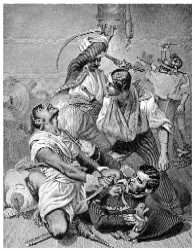
The first object I met was a man bearing a limb, which had just been detached from some suffering wretch…. The surgeon and his mate were smeared with blood from head to foote: they looked more like butchers than doctors….Our carpenter…had his leg cut off. I helped to carry him to the after wardroom, but he soon breathed out his last life there, and then I assisted in throwing his mangled remains overboard…. It was with exceeding difficulty I moved…it was so covered with mangled men and so slippery with blood….(Estes, 65)
As I was dressing a wounded man, a cannon ball struck a young gentleman on the head dashing his brains upon all sides; part of them blinded me. At this moment a splinter struck my head and rendered me insensible for quarter of an hour. Upon my recovery, I could hardly persuade myself but what I was mortally wounded, from being completely besmeared with blood and brains. Alas! when I beheld my friend and companion without a head, I could not avoid reflecting with emotions of grief; but the field of battle being no place for weeping or lamentations…I contented myself with the usual expression upon the field of battle – poor fellow, there he lies and ends his career. (Lowry, 44)
The generall himself was shot in the face under his right eye and close by his nose, the arrow piercing a marvelous way in underbasis cerebris with no small danger of his life besides that, he was grievously wounded in the head. The rest being nine persons in the boat, were deadly wounded in divers parts of their bodies, if God almost miraculously had not give cure to the same. For our chief Surgeon being dead and the others absent by the loss of our vice-admirall, and having none left us but a boy, whose good will was more than any skil he had, we were little better than altogether destitute of such cunning and helps as so grievous a state of so many wounded bodies did require. Notwith standing God, by the very good advice of our Generall and the diligent putting too of every man’s help, did give such speedy and wonderful cures, that we had all great comfort thereby and yielded God the glory, whereof.(Friedenberg, 17)
…as I was standing near the pump, with a top maul in my right hand, with the arm extended, a shot from the enemy’s ship entered the port near by, and took the arm off just above the elbow, leaving it hanging by my side by a small piece of skin; also wounding me severely in the side, leaving my entrails all bare. I then took my arm in my left hand, and went below…and requested the surgeon to stop [the bleeding in] my arm [as it] was already off. He accordingly stopped the effusion of blood, and I was laid aside among the dead and wounded, until my turn came to have my wounds dressed…. I was so exhausted that I fell asleep…until…I was…laid on a table, my wounds washed clean, and my arm amputated and thrown overboard.(Langley, 58)
We held [one man] while the surgeon cut off his leg above the knee. The task was most painful to behold, the surgeon using his knife and saw on human flesh and bones as freely as the butcher at the shambles.(Estes, 65)
A strip of cotton cloth about 2 feet long and 8 inches wide torn up the centre from one end for half the length is then to be drawn over the flesh closed around the bone. The ends are brought together and the whole serves to draw the skin and flesh up while the bone is sawed off. Very little pain is felt from sawing a bone – If there is any splinter or corner left it should be pinched off with nippers.3
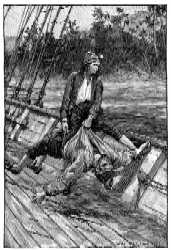
Joseph Bonheur had his right thigh taken off by a cannon shot close to the pelvis, so that it was impossible to apply a tourniquet; his right arm was also shot to pieces. The stump of the thigh, which was very fleshy, presented a dreadful and large surface of mangled flesh. In this state he lived near two hours, perfectly sensible and incessantly called out in a strong voice to me to assist him…. All the service I could render…was to put dressing over the part and give him drink.
Pyrate Surgeons Bibliography
Anderson, Ron. “The Most Dangerous Man Aboard,”No Quarter Given(July 1999),
Breverton, Terry.Black Bart Roberts: The Greatest Pirate of Them All. Pelican, 2004.
Brown, Stephen R.Scurvy: How a Surgeon, a Mariner, and a Gentleman Solved the Greatest Medical Mystery of the Age of Sail. St. Martin’s Press, 2003.
Coote, Stephen.Drake: The Life and Legend of an Elizabethan Hero. St. Martin’s Press, 2003.
Cordingly, David.Women Sailors; Sailors’ Women. Random House, 2001.
Daniel, Mike. “The French Pox,”No Quarter Given(September 1999), 10.
Darwin, Tess.The Scots Herbal: The Plant Lore of Scotland. Mercat Press, 1997.
Druett, Joan. “Privateer Medicine Chest,”No Quarter Given(September 1999), 7-9. Druett, Joan. Rough Medicine. Routledge, 2000.
Eastman, Tamara. “The Medicine Chest,”No Quarter Given(July 1999), 5.
Estes, J. Worth.Naval Surgeon: Life and Death at Sea in the Age of Sail. Science History Publications, 1998.
Folsom, James.Mariner’s Medical Guide. James Folsom &; Co., 1884.
Friedenberg, Zachary B. Medicine Under Sail. Naval Institute Press, 2002.
Lampe, Christine Markel. “Three Special Syringes,”No Quarter Given(July 1999), 5.
Langley, Harold D.A History of Medicine in the Early U.S. Navy. Johns Hopkins University, 1995.
Lee, Robert E.Blackbeard the Pirate: A Reappraisal of His Life and Times. John F. Blair, 2002.
Little, Benerson.The Sea Rover’s Practice. Potomac Books, 2005. Longfield-Jones, G. M. “Buccaneering Doctors,” Medical History36 (1992), 187-206.
Lowry, James.Fiddlers and Whores: The Candid Memoirs of a Surgeon in Nelson’s Fleet. Chatham, 2006.
Rediker, Marcus.Between the Devil and the Deep Blue Sea. Cambridge University Press, 1999.
Ringrose, Basil. “The Dangerous Voyage and Bold Attempts of Captain Bartholomew Sharp and Others Performed Upon the Coasts of the South Sea for the Space of Two Years,” in John Esquemeling’sThe Buccaneers of America. The Rio Grande Press, 1992.
Selinger, Gail.Complete Idiot’s Guide to Pirates. Alpha, 2006. Stewart, Wesley. “Sea-going Surgeons,” No Quarter Given(July 1999), 4.
Vallar, Cindy. "," Pyrate SurgeonsPirates and Privateers(May-July 2007).